
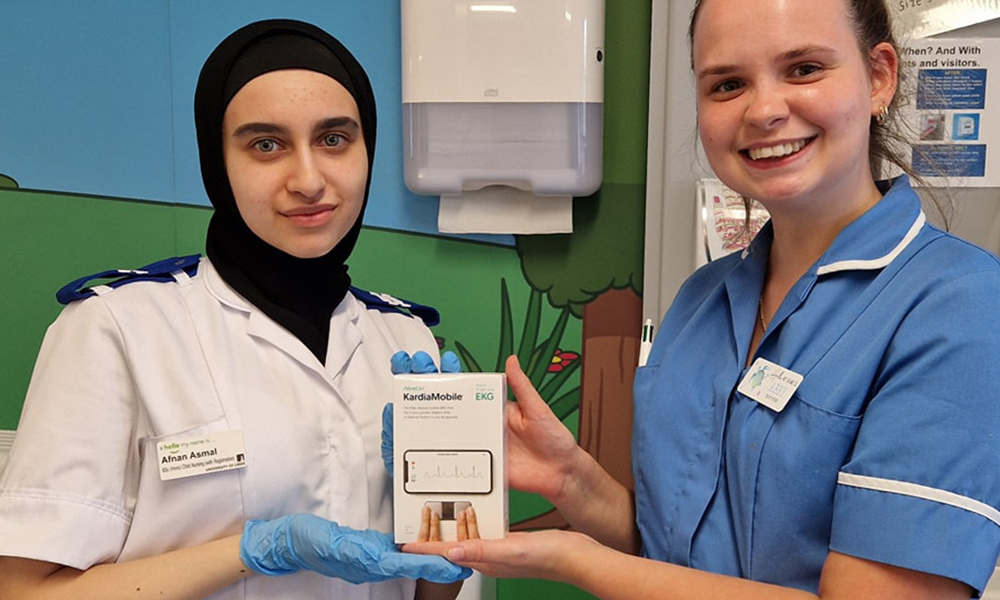
KardiaMobiles are transportable and easy to use devices and are effectively personal ECG monitors, which work with smartphones.
They monitor heart rhythms amongst patients who have experienced symptoms, either providing peace of mind or vital data to enable clinicians to reach a diagnosis.
Regional cardiac nurse specialist Paula Cowgill – whose role is funded by CHSF – works at Calderdale Royal Hospital in Halifax and received 10 of these devices for patients.
14-year-old Jude Terry from Portsmouth near Todmorden, was given a Kardia mobile by Paula, and it helped diagnose his heart condition.
Jude’s dad, Paul, told us…
“For the last few years Jude was experiencing extremely high heart rates with no apparent reason.
“We had our own monitors for heart rate, such as the finger device or even a watch that recorded heart rate – and it was up and over 220 BPM.
“Jude said it felt like his heart was pounding out of his chest. He would get very sweaty and would start to panic and worry (as would we).

Nurse Specialist Paula with KardiaMobile devices funded by CHSF
“These episodes could last from as little as five minutes to up to 30 minutes. The advice we received was to try and get Jude to A&E so he could have an ECG performed to try and see what was going on.
“The issue with this was that we live over 40 minutes away from the nearest hospital and the heart rate would have returned to normal before we had arrived at the A&E department.


“The KardiaMobile turned out to be a brilliant tool, Jude told us he was having an episode, he came to tell us, and we performed the test. As it turned out we only needed to capture one result as there was enough information on the Kardia result that they could diagnose Jude straight away.
“Initially it took a little bit of reading of the step-by-step instructions that were provided, but the app was really simple to use, user-friendly enough so Jude knew exactly how to use it for when he took it to school with him.
“I certainly would recommend to other people as this worked first time for Jude, more so if people cannot get access to an ECG machine!”
Paul says Jude received a diagnosis as a result of data recorded on the Kardia device, and is now on a treatment plan:
“Jude was diagnosed with Supraventricular tachycardia (SVT) very shortly after the results were emailed to Paula. She then guided us through the next steps.
“First, Jude was placed onto some medication (beta-blockers) to help with the symptoms. We were then referred to Leeds to meet the specialist. There, options were discussed on the next steps.
“This was either medication for the rest of his life or surgery to fix the issue. Jude decided he wanted the surgery so we are now on the waiting list, expecting surgery around Spring 2025.”


NEW HD HEAD CAMERA FOR SURGEONS THANKS TO RHODES FAMILY
We're saying a huge thank you to the friends and family of heart warrior Bella Rhodes. Because of your incredible donations, CHSF have been able to purchase a state of the art surgical camera to be used during open heart surgery.Thanks to the amazing genrosity of the...

Presents for Arkhan
Thanks to your donations, one little boy on Ward 51 had a visit from a fellow superhero and a birthday to remember!A Ward 51 doctor dressed as SpidermanWe know it's true to say that small, less costly gifts can make all the difference. And this is certainly...

Thank you for funding the Baby MRI Pod!
We made it, together! Thanks to YOUR amazing fundraising efforts we have reached the fundraising target for the MRI Baby Pod. And we have a lot of organisations and individuals to thank... We are incredibly grateful to everyone who supported our Baby MRI Incubator...