
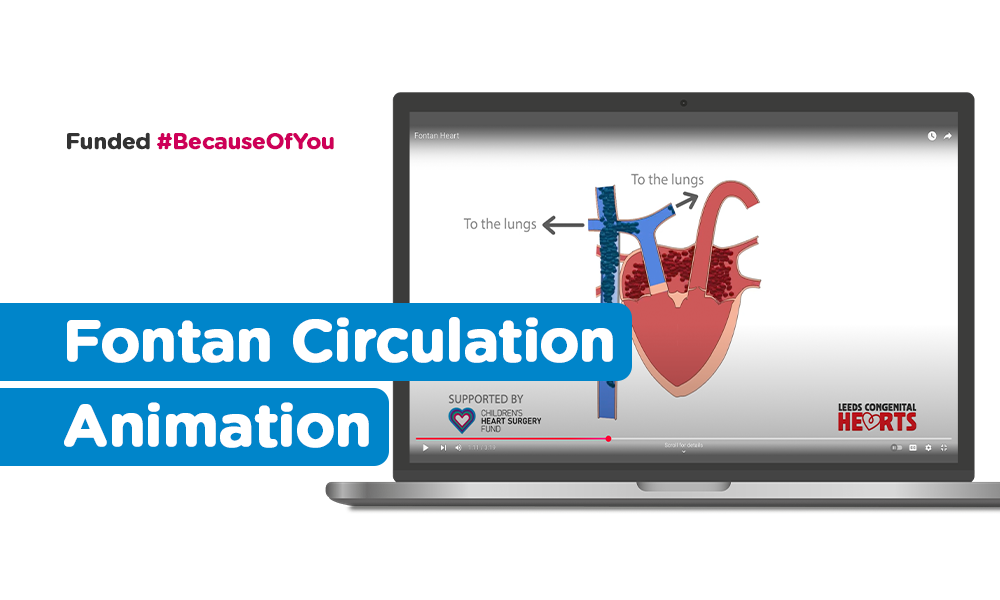
Thanks to your donations, we have just released a new animated video explaining the Fontan circulation and how patients with single ventricle heart defects are typically treated.
This video was created in collaboration with specialists from the Leeds Congenital Heart Unit, and our colleagues at Feature Media.
In a normal heart, blood flows in a circuit. The right ventricle pumps deoxygenated (‘blue’) blood to the lungs, where it picks up oxygen, and then the oxygenated (‘red’) blood returns to the left ventricle, which pumps it out to the body.
Here is an animation showing the normal heart:
In single ventricle conditions, part of the heart is underdeveloped, so a series of operations are required to ensure the body gets enough oxygen.
These operations result in “The Fontan Circulation”. This video shows the Fontan circulation in more detail:
Please note that this video illustrates the Fontan Circulation very simply and not all single ventricle conditions are the same, therefore some patients may have had/need different operations/treatment.
The aim of the Fontan operation is to separate the blood to ensure that only blue blood goes to the lungs and red blood is pumped to the body. This is done by connecting the veins that carry blood that is low in oxygen from the body directly to the lungs where it picks up oxygen. Blood that is full of oxygen then goes to the heart and is pumped to the body.
Patients with a Fontan circulation require lifelong monitoring and management by healthcare professionals. This includes regular check-ups, imaging, and interventions as needed to address potential complications.
The procedure gets its name having been initially performed in 1968 by Francis Fontan and Eugene Baudet from Bordeaux in France. The operations are usually carried out between the ages of a few months old to around 5 years of age.
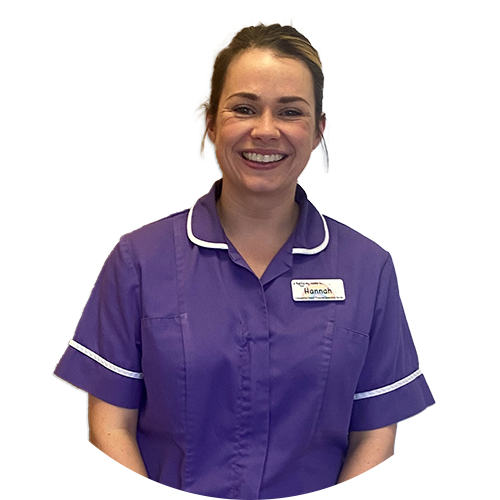
Hannah Swift, Adult Congenital Heart Disease Nurse Specialist, said:
“Sometimes it can be hard to explain the different heart conditions to patients and families, so these videos provide a simple, visual aid to help ensure people understand their heart conditions. We also use them for training and education of staff members all over the region.
“The Fontan Circulation can be particularly difficult to understand so we were keen to develop a new video with Feature Media and thanks to CHSF and its supporters we have been able to… Thank you!”
Because of You, CHSF have been able to fund a range of other CHD videos covering a range of common congenital heart defects and treatments.
Please note: Children’s Heart Surgery Fund is not a medical resource and cannot provide medical advice.
Heart conditions are very individual and what can be right for one person could potentially be dangerous for another. If you have any questions about yours or your child’s condition, please get in touch with Leeds Congenital Heart Unit directly, or the specialist nurses.
- www.leedsth.nhs.uk/services/congenital-heart-unit has lots of information, and is a great place to start
- Children’s Cardiac Nurse Specialists
ccns.lgi@nhs.net
0113 3925467
(Please leave a voicemail, your child’s date of birth, their NHS Number if you have it, and your telephone number)
- Adult Cardiac Nurse Specialists
leedsth-tr.achdnurse@nhs.net
0113 3928154
(Please leave a voicemail, your date of birth, your NHS number if you have it and your telephone number)

Toy MRI for MRI Research
With your help we have funded some special toy MRI equipment to help young patients. MRI research nurse Ruth Foley tells this very special “Because of You” story! Meet James! James is 6 years old and has Tetralogy of Fallot. Read his backstory here. James came to...

Two Vein Viewer Flex Machines!
We would like to give a huge thank you to Sovereign Health Care for helping us fund two Vein Viewer Flex Machines! A Vein Viewer Flex uses infrared to show a patient’s veins beneath the skin. This helps makes the experience of blood tests or cannulas more positive for...

Pedestal Mounted Contrast Injector
CHSF like to extend a huge thanks to the Hospital Saturday Fund (HSF) for funding a piece of medical equipment within the hybrid theatre called a Pedestal Mounted Contrast Injector. This is a crucial piece of medical technology used by clinicians to assist them in...