

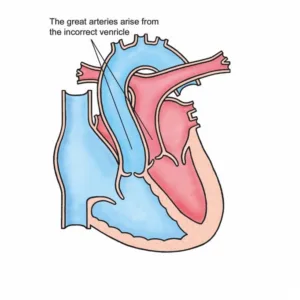
This is a serious heart condition in which the main artery which should arise from the right side of the heart comes from the left side, and the artery which should arise from the left side of the heart comes from the right side.
In the normal circulation blue blood, in which the oxygen has been used up by the body, drains to the right side of the heart which pumps the blood to the lungs. In the lungs oxygen is collected, making the blood pink (or “oxygenated”). The pink blood is then returned to the left side of the heart which pumps the pink blood to the body.
In a baby with Transposition of the Great Arteries the blue blood gets pumped back to the body instead of to the lungs, the baby appears blue shortly after birth and may die quickly without treatment.
Normal heart:
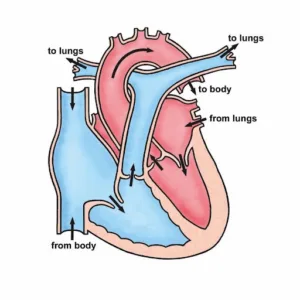
Image of a heart with Transposition of Great Arteries:
Tests
Usually an ultrasound scan (“echocardiogram”) is required to make the diagnosis.
Treatment
The first stage of treatment is to keep the baby alive by increasing the amount of oxygenated blood which gets to the body. Medicines can help to some extent and most babies will be given a drug called dinoprostone, as an injection into one of the veins. Almost all babies with Transposition of the Great Arteries will also need a procedure called a “balloon septostomy” to make sure they get enough oxygen to their body to survive. This involves putting a tube with a small balloon at its tip into the vein at the top of the leg or in the umbilicus. The tube is passed up into the heart and across the flap of heart tissue which separates the two small filling chambers, using an ultrasound scan to see it is in the correct position. The balloon is then inflated and the catheter is pulled back across the flap, tearing a hole in it and allowing oxygenated blood to cross from the left side of the heart to the right side.
Once the baby is safe, we can plan the baby’s operation to “switch” the arteries. The switch is usually done within the first two weeks after birth. Most babies are well enough to go home 5-7 days after the operation. Prior to surgery, the surgeon will discuss the operation in more detail including the risk and potential complications.
Complications can sometimes occur late, even many years after a successful switch operation, and it is important to have occasional but regular visits to the outpatient clinic to make sure all is well as the baby grows and even throughout adult life too.
Late problems which can arise include narrowing of the arteries leading to the lungs (the pulmonary arteries), leaking heart valves (most commonly the aortic valve), and narrowing of the small arteries (the coronary arteries) which feed blood to the heart muscle. These complications are all rare but can be serious enough to need further surgery or keyhole treatment.
General advice for the future
Most children lead a normal active life after a switch operation, including sports. If there are any particularly strenuous activities to be avoided your cardiologist will let you know.
All patients who have had a switch operation will be at risk of infection in the heart (called endocarditis) after surgery. Such infections may be caused by infections of the teeth or gums. It is important to visit the dentist regularly (every 6-12 months). Ear or body piercing and tattooing are best avoided as they also carry a small risk of infection which may spread to the heart.
For more information about endocarditis go to: www.leedsth.nhs.uk/patients/resources/infective-endocarditis-what-to-do-to-avoid-it
Contact
Please note: Children’s Heart Surgery Fund is not a medical resource and cannot provide medical advice. Heart conditions are very individual and what can be right for one person could potentially be dangerous for another. If you have any questions about yours or your child’s condition, please get in touch with Leeds Congenital Heart Unit directly, or the specialist nurses.
If you have any questions about your or your child’s heart condition, please contact the Cardiac Nurse Specialists
Children’s Cardiac Nurse Specialists
Phone number: 0113 3925467
Email: ccns.lgi@nhs.net
Adult Cardiac Nurse Specialists
Phone number: 0113 3928154
Email: leedsth-tr.achdnurse@nhs.net
Stories
Get the latest news, updates, and opinion from the Children’s Heart Surgery Fun Team
UK first for Leeds Congenital Echo Team
Support for families: June 2026
Ruth’s Round-up | July 2026
Join the CHSF team: Corporate Partnerships Manager
Join Our Facebook Group
Our private community group on Facebook is a peer-support forum for heart families to network with others who have shared experiences

Support for Families
We can offer a range of practical, wellbeing, financial and sign-posting support for our families at every stage of thir heart journey.