

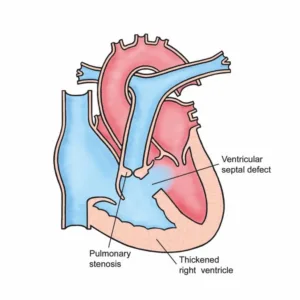
Tetralogy of Fallot is a serious heart abnormality in which there are two main problems:
- There is a narrowing in the right sided pumping chamber of the heart (the right ventricle) just below the outlet valve (the pulmonary valve) which lets blood pass from the heart to the artery which feeds the lungs with blood (the pulmonary artery). The outlet valve itself is also usually narrowed.
- There is a large hole (ventricular septal defect or VSD) between the two main pumping chambers (ventricles) of the heart.
In the normal circulation, blood passes through the lungs to collect oxygen from the air. In babies with Tetralogy of Fallot the narrowing in the heart causes blood flow to the lungs to be reduced, making the blood oxygen level low. This makes the baby (particularly the lips and hands) appear blue. How blue the baby looks depends on how severe the narrowing in the heart is; some babies appear pink or are just slightly blue when they cry but others may appear blue all the time. Some children with Tetralogy of Fallot may have attacks where they become suddenly very blue or very pale or floppy or faint. These are known as “hypercyanotic attacks” or are sometimes called “spells”. If your child has episodes like this you should tell us immediately as these can be very serious and may even be life threatening.
Hypercyanotic Spell/Blue Episode
A typical episode will involve your baby being very upset. They will then turn very blue or purple, and become pale and floppy afterwards. This is more likely to happen if they are unwell, especially if they are not feeding well. Some of these symptoms may be mild or less obvious, so please seek medical advice if you are unsure.
What to do if your child has a spell
- Keep them as calm as possible. Give them a cuddle and bring their knees up to their chest.
- If it stops quickly and your baby remains well, call the cardiac specialist nurses.
- If your baby goes pale and floppy, loses consciousness or the spell lasts longer than one minute call 999 stating ‘my child is having a hypercyanotic spell’.
Normal heart:
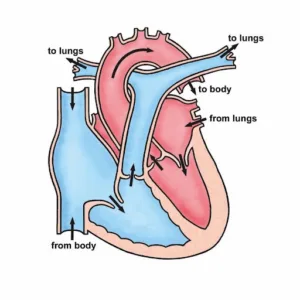
Image of a heart with Tetralogy of Fallot:
Tests
Only a simple ultrasound scan (“echocardiogram”) is required. Sometimes additional imaging with a CT scan is required.
Treatment
Surgery is usually planned at 6-12 months of age, but the type and timing of treatment depends on how blue an individual baby becomes as well as how well the pulmonary arteries (the lung arteries) grow. If the pulmonary arteries do not grow well, it may be necessary to perform a “shunt” or “keyhole” operation to improve the blood supply to the lungs before we can consider major surgery to repair the heart. If the arteries have grown well we usually plan a single operation to close the hole (VSD) by sewing a patch over it and to open up the narrowing (pulmonary stenosis) in the heart. This is often referred to as “corrective” surgery, but it never makes the heart completely normal. You will meet the surgeon prior to the operation who will discuss surgery in detail including the risks and potential complications of the procedure.
After the operation
Most children are in hospital for 5-7 days after their operation. Most children have medicines to take at home after leaving hospital but these are only necessary for a month or so. Visits to the outpatient clinic will be necessary after the operation.
Other abnormalities
Some children with Tetralogy of Fallot have other abnormalities. The commonest of these is a genetic abnormality, where a small part of one chromosome is missing. This abnormality is called “22q11 deletion syndrome”.
Although some children with 22q11 deletion grow and develop normally, some will have learning or speech difficulties and if your child has 22q11 deletion it is important that his or her development is monitored so that help can be given early if necessary.
A blood test to check for this abnormality can be taken, but it may take some weeks for the result to come back.
The long-term future
All patients who have had Tetralogy of Fallot repair operations have an abnormal pulmonary valve.
This means further surgery may be necessary in older children and adults to replace the valve, so regular check-ups are required. Even many years after surgery new problems may arise which may require treatment.
One of the commonest late problems is the development of abnormal heart rhythms. These can usually be treated but can be serious and can even rarely be fatal, so regular review in outpatients by a specialist is very important even if the child appears well.
General advice for the future
Most patients with repaired Tetralogy of Fallot will lead normal active lives after their operation but may not manage as much physical exercise as a normal child. We do not usually stop children with heart disease from doing exercise but it is probably best to avoid really hard physical exercise (such as long distance competitive running) even after a successful operation.
All children with Tetralogy of Fallot will be at risk of infection in the heart (called endocarditis), before and after surgery. Such infections may be caused by infections of the teeth or gums. It is important to look after your child’s teeth and visit the dentist regularly (every 6-12 months).
Ear or body piercing and tattooing are best avoided as they also carry a small risk of infection which may spread to the heart.
For more information about endocarditis go to: https://www.leedsth.nhs.uk/patients/resources/infective-endocarditis-what-to-do-to-avoid-it/
Contact
Please note: Children’s Heart Surgery Fund is not a medical resource and cannot provide medical advice. Heart conditions are very individual and what can be right for one person could potentially be dangerous for another. If you have any questions about yours or your child’s condition, please get in touch with Leeds Congenital Heart Unit directly, or the specialist nurses.
If you have any questions about your or your child’s heart condition, please contact the Cardiac Nurse Specialists
Children’s Cardiac Nurse Specialists
Phone number: 0113 3925467
Email: ccns.lgi@nhs.net
Adult Cardiac Nurse Specialists
Phone number: 0113 3928154
Email: leedsth-tr.achdnurse@nhs.net
Stories
Get the latest news, updates, and opinion from the Children’s Heart Surgery Fun Team
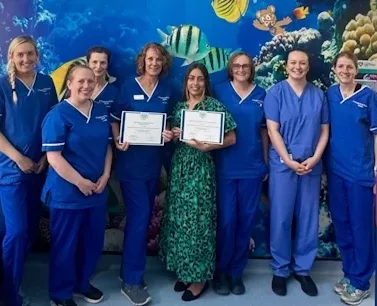
UK first for Leeds Congenital Echo Team
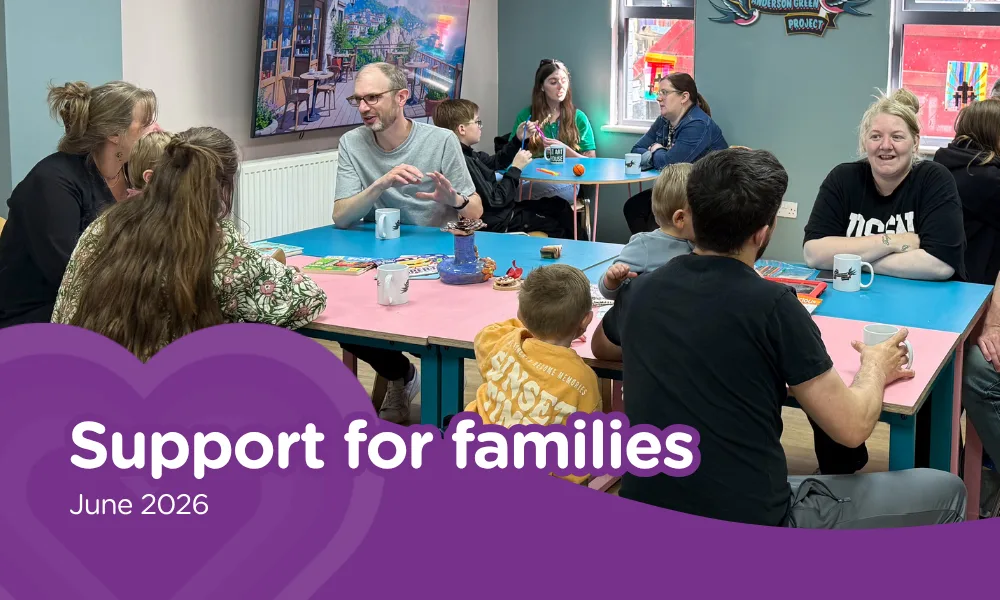
Support for families: June 2026
Ruth’s Round-up | July 2026
Join the CHSF team: Corporate Partnerships Manager
Join Our Facebook Group
Our private community group on Facebook is a peer-support forum for heart families to network with others who have shared experiences

Support for Families
We can offer a range of practical, wellbeing, financial and sign-posting support for our families at every stage of thir heart journey.