

A ventricular septal defect (VSD) is a hole in the wall between the two main pumping chambers of the heart (the ventricles). Some patients have more than one VSD.
Normal heart:
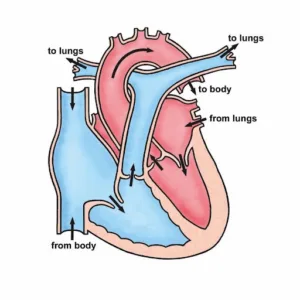
Image of a heart with Ventricular Septal Defect (Large):
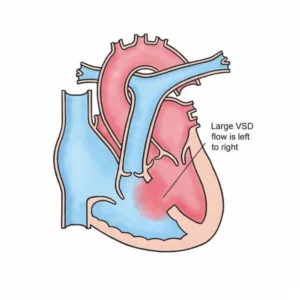
In the normal heart the left ventricle works at high pressure and pumps blood to the body and the right ventricle works at low pressure and pumps blood to the lungs. When there is a hole between the two ventricles (a VSD), blood flows from the left ventricle to the right ventricle through the hole. This causes the blood flow and the blood pressure in the right ventricle and in the arteries feeding the lungs (the pulmonary arteries) to be increased.
Babies with a VSD usually appear perfectly well in the first few weeks of life, but many gradually become breathless over the first month after birth because the increased blood flow to the lungs makes the lungs congested. Babies who are very breathless often cannot feed normally and may not gain weight easily because they put so much energy into breathing. Even quite big VSDs can gradually get smaller or even close off completely on their own as the child grows. However, if the VSD remains large enough to cause high blood pressure in the lungs for a long time (more than a year or so) there is a serious risk that the arteries in the lungs will become permanently damaged by the high blood pressure. This is a very serious complication (“pulmonary vascular disease”) and the child will gradually become more and more breathless and blue over a period of some years and will eventually die because of the damage to the lungs.
Tests
In most patients a simple test such as an ultrasound scan of the heart (“an echocardiogram”) is required to measure the size of the VSD and level of blood pressure in the lungs.
Treatment
Sometimes medicines can help to make the patient less breathless, but medicines cannot make the VSD smaller. If the VSD stays big as the child grows, surgery will be necessary.
In most cases it is possible to close the hole (or holes) but sometimes an operation, called a pulmonary artery band, is performed to reduce the amount of blood flowing to the lungs so that the bigger operation to close the hole can be delayed until the child is bigger. The operation to close the VSD involves opening the chest and sewing a patch of material over the VSD while the heart is stopped and its function is taken over by a machine (cardiopulmonary bypass). The operation takes about 4 hours and usually involves a stay in hospital of about 5-7 days, as long as the baby is feeding well. Most children are completely back to normal activities within 6 weeks after the operation. You will meet the surgeon prior to the operation , who will explain the operation in more detail including risks and potential complications.
Long term future
It is rare to need further treatment after surgery. Some patients will require medicines but this is usually only for a short time. Occasional outpatient visits are usually recommended even if the child is well, to make sure that the repair remains satisfactory as the child grows. They may be discharged later in childhood.
Most children lead completely normal lives after surgery to close a VSD.
General advice for the future
All patients with a VSD will be at risk of infection in the heart (called endocarditis) before surgery and if there is a small residual VSD after the operation there will still be a small risk of infection in the heart. Such infections may be caused by infections of the teeth or gums. It is important to look after your child’s teeth and visit the dentist regularly (every 6-12 months). Ear or body piercing and tattooing are best avoided as they also carry a small risk of infection which may spread to the heart.
For more information about endocarditis go to: https://www.leedsth.nhs.uk/patients/resources/infective-endocarditis-what-to-do-to-avoid-it/
Contact
Please note: Children’s Heart Surgery Fund is not a medical resource and cannot provide medical advice. Heart conditions are very individual and what can be right for one person could potentially be dangerous for another. If you have any questions about yours or your child’s condition, please get in touch with Leeds Congenital Heart Unit directly, or the specialist nurses.
If you have any questions about your or your child’s heart condition, please contact the Cardiac Nurse Specialists
Children’s Cardiac Nurse Specialists
Phone number: 0113 3925467
Email: ccns.lgi@nhs.net
Adult Cardiac Nurse Specialists
Phone number: 0113 3928154
Email: leedsth-tr.achdnurse@nhs.net
Stories
Get the latest news, updates, and opinion from the Children’s Heart Surgery Fun Team
UK first for Leeds Congenital Echo Team
Support for families: June 2026
Ruth’s Round-up | July 2026
Join the CHSF team: Corporate Partnerships Manager
Join Our Facebook Group
Our private community group on Facebook is a peer-support forum for heart families to network with others who have shared experiences

Support for Families
We can offer a range of practical, wellbeing, financial and sign-posting support for our families at every stage of thir heart journey.