

This is a serious heart abnormality which consists of a complicated hole between the right and left sides of the heart.
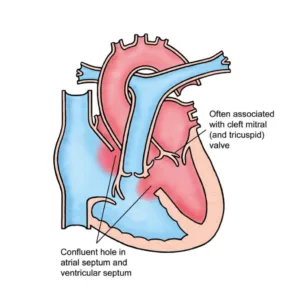
The hole occurs in the middle of the heart, causing a large hole between the two small pumping chambers (atria) and the between the two main pumping chambers (ventricles). The hole also affects the inlet valves of the heart.
Normally there is a separate inlet valve in the right side of the heart (the tricuspid valve) and a separate inlet valve in the left side (the mitral valve) but in an atrioventricular septal defect (AVSD) there is just one common valve.
This abnormality of the inlet valves in AVSD often stops the valves (particularly the mitral valve, on the left side of the heart) closing properly, so it is not watertight when it closes.
Normal heart:
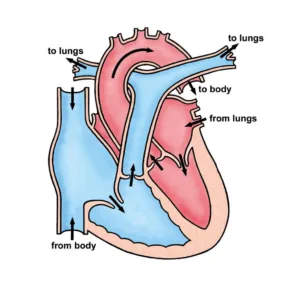
Image of a heart with Atrioventricular Septal Defect (AVSD):
Treatment
Babies with AVSD usually look perfectly well when they are born, but they gradually become breathless over the first month or so after birth. When this happens medicines can help to some extent, but most babies require major heart surgery to try to repair the defect when they are about 3 months old. The surgery is very complicated because the surgeon has to try to close the 2 holes (using patches of material) at the same time as dividing the common inlet valve into two separate competent valves.
The main problem with surgery is that the left sided inlet valve always leaks to some extent after the holes are closed (this is called left AV valve regurgitation. If the left AV valve only leaks a little this may not matter and further treatment may never be necessary).
Here’s a video about Atrioventricular Septal Defect – AV Canal by Cincinnati Children’s Hospital
However if the left AV valve leaks badly it can be such a serious problem that the baby may die, or that further major surgery is needed to repair or replace the valve. Replacing the left AV valve (a metal valve is normally used) in small babies is a difficult procedure, carries a further risk to the baby‘s life and sometimes cannot be performed because the baby is too small. Anticoagulation therapy is necessary for life with a mechanical valve.
Further major surgery is always necessary after valve replacement in babies because they outgrow the valve. The risk of a baby dying at surgery to repair an AVSD will depend to some extent on how well the mitral valve works before the operation. 25% of children undergoing AVSD repair may require further surgery when they become adults.
Follow up
It is important for all children with a repaired AVSD to be seen in the cardiology outpatient department to make sure that mitral regurgitation does not become worse.
In addition, a small proportion of children can develop narrowing of the outflow of the left ventricle (subaortic stenosis) after repair of the AVSD. This may need surgical treatment.
General advice for the future
Children with repaired AVSD can live normal active lives, including all kinds of sport. Most have a normal exercise tolerance but if there is significant mitral regurgitation it is usual to be more breathless than normal on exercise.
All patients with a repaired AVSD will be at risk of infection in the heart (called
endocarditis). Such infections may be caused by infections of the teeth or gums. It is important to have good dental hygiene and to visit the dentist regularly. Ear or body piercing and tattooing are best avoided as they also carry a small risk of infection which may spread to the heart.
For more information about endocarditis go to: https://www.leedsth.nhs.uk/patients/resources/infective-endocarditis-what-to-do-to-avoid-it/
Contact
Please note: Children’s Heart Surgery Fund is not a medical resource and cannot provide medical advice. Heart conditions are very individual and what can be right for one person could potentially be dangerous for another. If you have any questions about yours or your child’s condition, please get in touch with Leeds Congenital Heart Unit directly, or the specialist nurses.
If you have any questions about your or your child’s heart condition, please contact the Cardiac Nurse Specialists
Children’s Cardiac Nurse Specialists
Phone number: 0113 3925467
Email: ccns.lgi@nhs.net
Adult Cardiac Nurse Specialists
Phone number: 0113 3928154
Email: leedsth-tr.achdnurse@nhs.net
Stories
Get the latest news, updates, and opinion from the Children’s Heart Surgery Fun Team
UK first for Leeds Congenital Echo Team
Support for families: June 2026
Ruth’s Round-up | July 2026

Join the CHSF team: Corporate Partnerships Manager
Join Our Facebook Group
Our private community group on Facebook is a peer-support forum for heart families to network with others who have shared experiences

Support for Families
We can offer a range of practical, wellbeing, financial and sign-posting support for our families at every stage of thir heart journey.